


Events - Season 2025-26
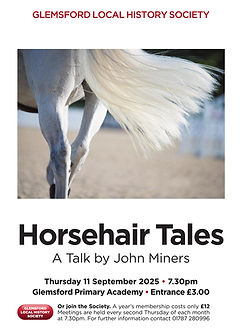
Our new programme of talks commenced in style with the return of John Minors, a textile consultant, who gave an audience of 49 a fascinating run through of the weaving of horse hair into cloth. Hugely relevant to Glemsford because of the two horse hair factories which existed here.
John worked at Courtaulds in Halstead for many years and told us about the horse hair industry in the 19th century that was based primarily on women and children working on looms in their own homes; often working 16 hours a day.
John Boyd of Castle Carey in Somerset opened his first factory in 1837 and employed 40 weavers, starchers and dyers. Boyd was the most prominent company and today it is still weaving horse hair into hair cloth for the many modern uses in upholstery, wall hangings, lamp shades and anything requiring a textile that will outlast any other material.
In Glemsford, the former horse hair factory in Bells Lane was owned by a company called Arnold and Gould. Originally, the factory would have used hair from local horses but because local supply was limited, it would import horse hair from other sources including from China.
The production of hair cloth on weaving looms is unique as no other animal hair can be used in textile products. Horse hair is indestructible and comes in white black and grey/brown but only the white hair can be dyed.
John’s fascinating talk concluded with a look at many samples.

Our November talk given by Kate Jewell was entitled ‘Schools and Education in Medieval Suffolk’. Way back in 1234, Pope Gregory decreed that within Christendom every parish priest should have a clerk who was responsible for bringing boys into education, and this was certainly prevalent in the Suffolk of the late 14 th to early 16 th century when records show that elementary school for the formal education of boys existed in many towns and villages. Education was always linked to religion. Boys from wealthy and well-to-do backgrounds often had to pay a fee to the local employer/landowner before being sent to
schools, the aim being to groom them for future priesthood. Books and documents still in existence show that the teaching, usually done by the local priests, was in both English and Latin and much was achieved ‘by rote’ chanting. Content included early alphabets and basic prayers, although in the grammar schools, which boys transferred to from the age of 12, more advanced primers were introduced containing collects, prayers, psalms, classical texts and lists of the seven sacraments and deadly sins. For these boarding schools, boys took with them an enormous pile of ‘necessaries’(clothes, shoes etc.); they sat on graded ‘forms’; texts were almost exclusively in Latin; discipline was strict and hours were long.
However, the boys did enjoy their food and hated Lent when diets were restricted! Kate concluded her talk by briefly mentioning the life of girls who were essential for the running of households, many, like Alice de Bryene from Acton, becoming more than proficient in management and control of large farming communities.
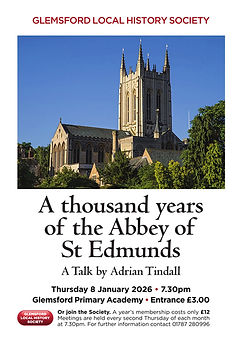
A dismally, wet and miserable January evening did not deter 41 members and visitors from attending Adrian Tindall’s talk entitled ‘The Monastery Alone a City’ - 1000 Years of the Abbey of St. Edmunds. Early research shows that Bury St. Edmunds was a significant town even in Saxon times, known then as Bedricesworth and by 630 AD Christianity and religious sites were prevalent. The martyrdom of King Edmund in 869/70 AD, set on record by Abbo de Fleury 100 years later, led to a great monastery being established by King Canute c.1020AD built around, and containing , the shrine of the murdered king. This was one of the greatest and wealthiest Benedictine monasteries in all of NW Europe, its wealth and power ever increasing until the Dissolution in 1539. Plans and archaeological digs show where the original buildings would have stood, the majority of them now in ruins showing only the flint-like inner structural core as the outer limestone facing stones have long been taken. Huge buildings such as the Norman Tower, St. James church (now the cathedral) and St. Mary’s church survived as they were all on the Abbey fringe, thus to be shared by the townsfolk. The present Abbey gate is a later addition, as the original one was destroyed by the local inhabitants in 1327- 46. (Angry relationships between town and Abbey were never cordial; the abbots were hated for their wealth and tight rein of town control). Today we can find evidence of the huge Abbey church, its nave, chapter house (with graves of six abbots!), chapels and crypt; some recent reconstructive pictures show how magnificent it would have been. The Great Court which housed stables, bake and brew houses and workshops is now the Abbey gardens, and many will recognise the Abbot’s bridge, still standing. Adrian’s most interesting talk certainly reminded us of what a fascinating
place the St Edmundsbury Abbey was, and still is today.

At February’s meeting speaker Andrew Mowbray took us on a ‘Virtually Colchester’ tour explaining, via maps and pictures, much of the history of this ‘oldest recorded town and newest city’ (2022). Evidence shows that the Celtic tribe Trinovantes had a settlement dating back to AD10, ruled by chieftains, situated in the Gosbecks area and known as
Camulodunon. In AD41 Emperor Claudius’ invasion resulted in a large Roman settlement being built on the hill where the city now stands. The Iceni tribe’s rebellion, led by Bouddicca in 60AD, destroyed the town, but it was rebuilt by the victorious Romans with even greater splendour. It boasted a theatre, an amphitheatre, a temple, gates and roadways, ( a chariot circus was also situated a fair way off!) all surrounded by a sturdy wall, much of which is still standing. Come 450AD the Romans had abandoned Colchester to neglection.
The 11 th . century saw the arrival of the Normans who adapted and improved much of what remained. Trinity Church tower maintains Roman brickwork, whilst St. Helena Chapel was Norman built. However, the ‘jewel in the crown’ is Colchester Castle built by the Normans, but standing over the original Roman temple which was erected in AD 54 by Nero to honour the murdered Emperor Claudius whose God-like status inspired worshippers.
Andrew concluded his talk by visiting the 17 th century describing the Dutch Quarter formally inhabited by Flemish weavers, and the horrors of the 11 week siege during the Civil War. Finally we heard of the chequered history surrounding the building of the ‘Jumbo’ Water Tower on the very top of the hill.
Colchester – a place really drenched in history!

Our March meeting welcomed a number of close friends and family members of speaker, Julie Whittle, who gave us a very well documented talk on ‘A Bulmer Family during World War II’. Using many photographs of the large Messant family who lived in Bulmer during the 1930s, we heard how, on the death of their parents in 1936, the oldest girl, Violet aged only 18,(and later to become Julie’s grandma!) took on the role of raising her younger siblings, Eileen and Molly. Times were hard and money short; war came in 1939 and the
male family members enlisted. The girls, along with others did many volunteering jobs, also working later for Vanners in Sudbury and Cornard Knitting Mills, yet by 1940 only Britain stood against the Nazis. Rationing was introduced; the Blitz raged, bombing in London
lasted for 57 consecutive nights; air raids were common, and then, on December 7 th 1941 Pearl Harbour was bombed! Bad mistake! In came the Americans, (‘overpaid, oversexed and over here’) in their droves, particularly in East Anglia with 3000 in Sudbury alone! Air Base dances became very popular with the girls, as did the US soldiers! When Operation Overlord was launched and Europe was invaded, losses on both sides were huge. Likewise, the Messant family had their fair share of tragedy, but, come the war’s ending, life returned to a version of normality. The surviving members married, had children
and did their best to found a dynasty!

Our May meeting welcomed back Pip Wright who treated the audience to a compelling story about Margaret Catchpole; an underrated Suffolk woman who had a colourful life. Born in 1768 to a poor family in Nacton, Margaret Catchpole started her adolescent life looking after her brother and sister whilst her parents both worked to bring income into the family home.
Pip illustrated Margaret’s life through watercolour pictures published in Richard Cobbold’s book of 1845. Not always historically accurate, Margaret is portrayed as a young lady who had the habit of getting involved with men, often with pistols in dawn fights between her “friends”. However, Margaret manages to get a job in the Cobbold household cooking and sewing and she became a welcome addition to the household, at one point rescuing a Cobbold child from a pond. Sadly, Margaret disgraced herself by inviting groups of men, often sailors, into the house for food and drink. Eventually the family showed Margaret the door and she seeks out Will Lord who she understands wants to marry her. Will was in London so Margaret steals a horse and dresses up as a boy to escape being caught. On arrival in London she is arrested and the Cobbold family seek her prosecution not realising that it was Margaret on the horse. Margaret receives a death sentence and resides at Ipswich gaol but in 1797 she is instead told she will be deported to Australia. Margaret escapes from the gaol dressed as a sailor but is soon captured and goes back to gaol where she goes on trial and is found guilty on the offence of trying to escape deportation. The judge however takes pity on her and rather than giving her a long sentence gives Margaret a more lenient sentence of deportation to Sydney, Australia. Historical accuracy then takes backseat but contemporary records suggest Margaret becomes a nurse and midwife and is celebrated in her new country as a heroin. She died in 1819 at the age of 51. Margaret Catchpole indeed had a colourful life.

Our last speaker in the current programme was Professor Mark Bailey who gave us a very erudite and engrossing talk on the subject of ‘The Effect of Global Climate Change on the East Anglian Coast 1100 – 1600’. It seems that there is little new about global climate change. Evidence shows that from the period 1000 until 1250 the climate was remarkably warm whilst the decades from 1450 – 1600 were much colder. Our understanding comes from some written evidence, and also from tree rings, the ice core, speleothem formations
such as stalactites and stalagmites and even the flood levels of the River Nile. The soft, vulnerable coast of Suffolk is low lying and has always been prey to the violent movement of the waves and the rising sea levels. From royal commissions and manorial surveys we can discover much about the changing face of the coastline. Truncated marine havens, closed off estuaries, emerging sandbanks, the weight of disposition and reclaimed land all show how, not just Dunwich, but also Covehithe, Orford, Southwold and Thorpeness lost their port status and importance. Centuries of changing climate have all taken their
toll and today we continue to monitor the situation very closely.